Home Lift
Home Lifts and Multi-Storey Living
Most home lifts are installed for accessibility rather than luxury: they keep the upper floors of a house usable as a household ages, and they are usually feasible in an existing building subject to structure.
- Written by
- Calvin A. W
- Technical review
- Tommy C
- Published
- Updated
- Reading time
- 6 min
Why households install one
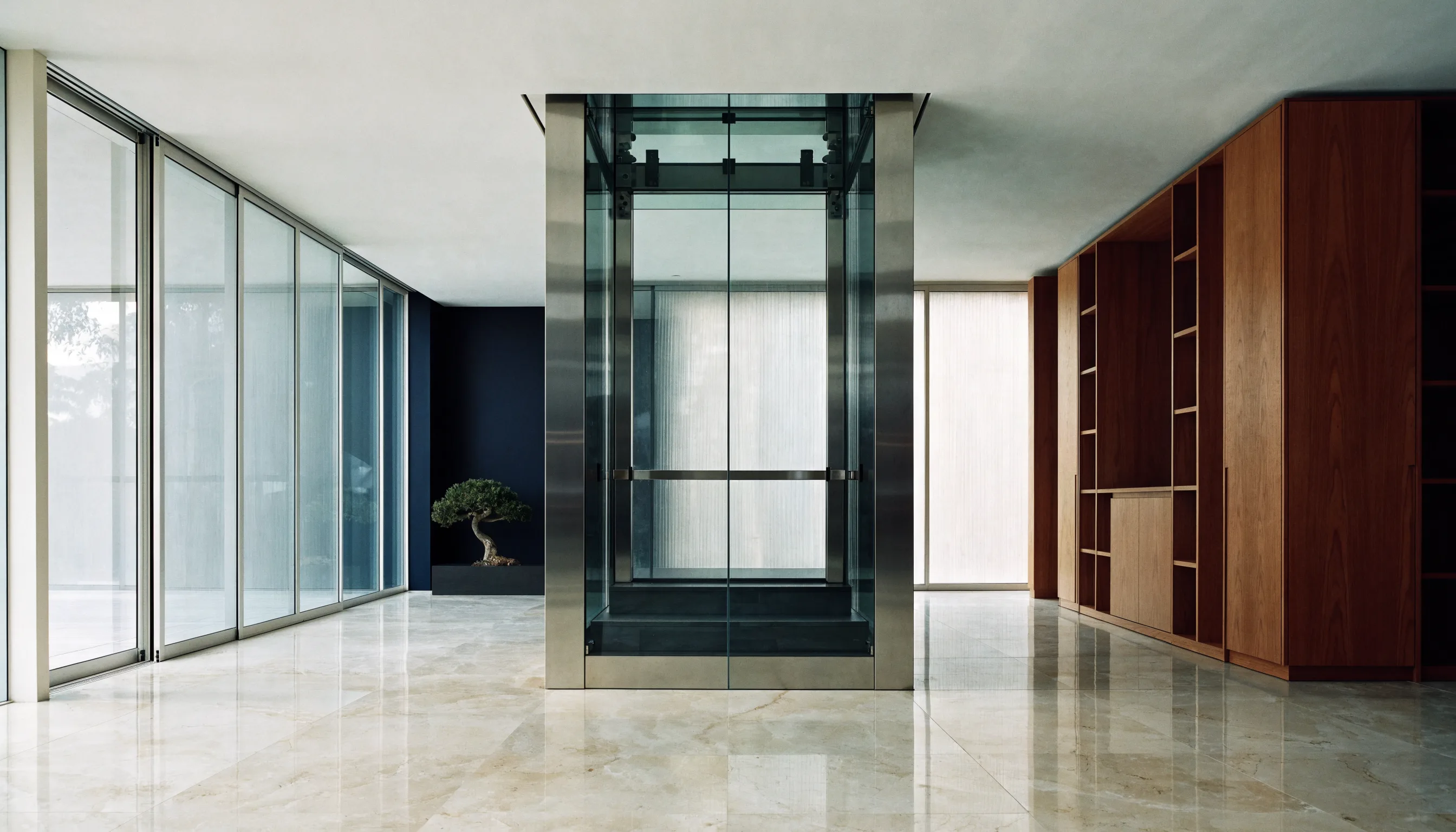
Two reasons account for most installations. The common one is accessibility: multi-storey living becomes difficult with age, injury or reduced mobility, and a lift keeps the upper floors of a house usable rather than forcing a move. The other is architectural, where a panoramic car is treated as part of the interior.
The accessibility case is the more durable of the two, because it is about the next twenty years of a household rather than the next renovation. A house that stays usable as its occupants age is worth more to them than one that does not.
Whether an existing house can take one
Usually yes, but structure decides it. A survey establishes where a shaft can be formed, whether the slab and foundations carry the loads, and what pit depth and headroom are achievable. That survey should happen before any equipment is selected, not after.
This is the reason the range is specified the way it is. A shallower pit is less groundwork, a lower overhead removes the need for a roof deck, and a narrower shaft returns floor area to the rooms around it.
What to ask before choosing
Drive type is the decision with the longest tail. Hydraulic systems are cheaper to install but need regular oil maintenance and disposal, can leak as seals age, and drift in speed and levelling as the oil warms. Traction costs more up front, uses no oil and wears slowly.
Questions worth answering first
- How many floors, and will that change
- Is there an existing shaft, or does one have to be formed
- What pit depth and headroom does the structure allow
- Traction, hydraulic or screw — and what each costs after handover
- What happens in a power cut
Sources
Where this comes from
- Prawita Karya home lift range — Tenka model figures and drive types as published on this site.
FAQ
Common questions
Is a home lift only worth it for large houses?
No. The constraint is structure rather than floor area, and the compact models exist precisely for houses where space is tight. Tsuki needs an 800 x 900 mm shaft and no pit.
Does a home lift add value to a property?
It keeps the whole house usable as a household changes, which is the part buyers and owners tend to value. Prawita Karya does not publish a figure for resale effect, because that depends on the local market rather than on the lift.