Home Lift
Why a Home Lift Should Run on a Battery in Indonesia
The Tenkai V300 takes its power from a battery, and the mains only charges that battery. Three things follow: the lift keeps running through a power cut, the house sees a slow charging draw instead of a surge each time the car starts, and that charging can happen off-peak or from solar. On a grid where a household buys a fixed connected load and an interruption is a condition to design for rather than an accident, that changes both what the lift costs to run and whether it can be installed at all.
- Written by
- Calvin A. W
- Technical review
- Tommy C
- Published
- Updated
- Reading time
- 8 min
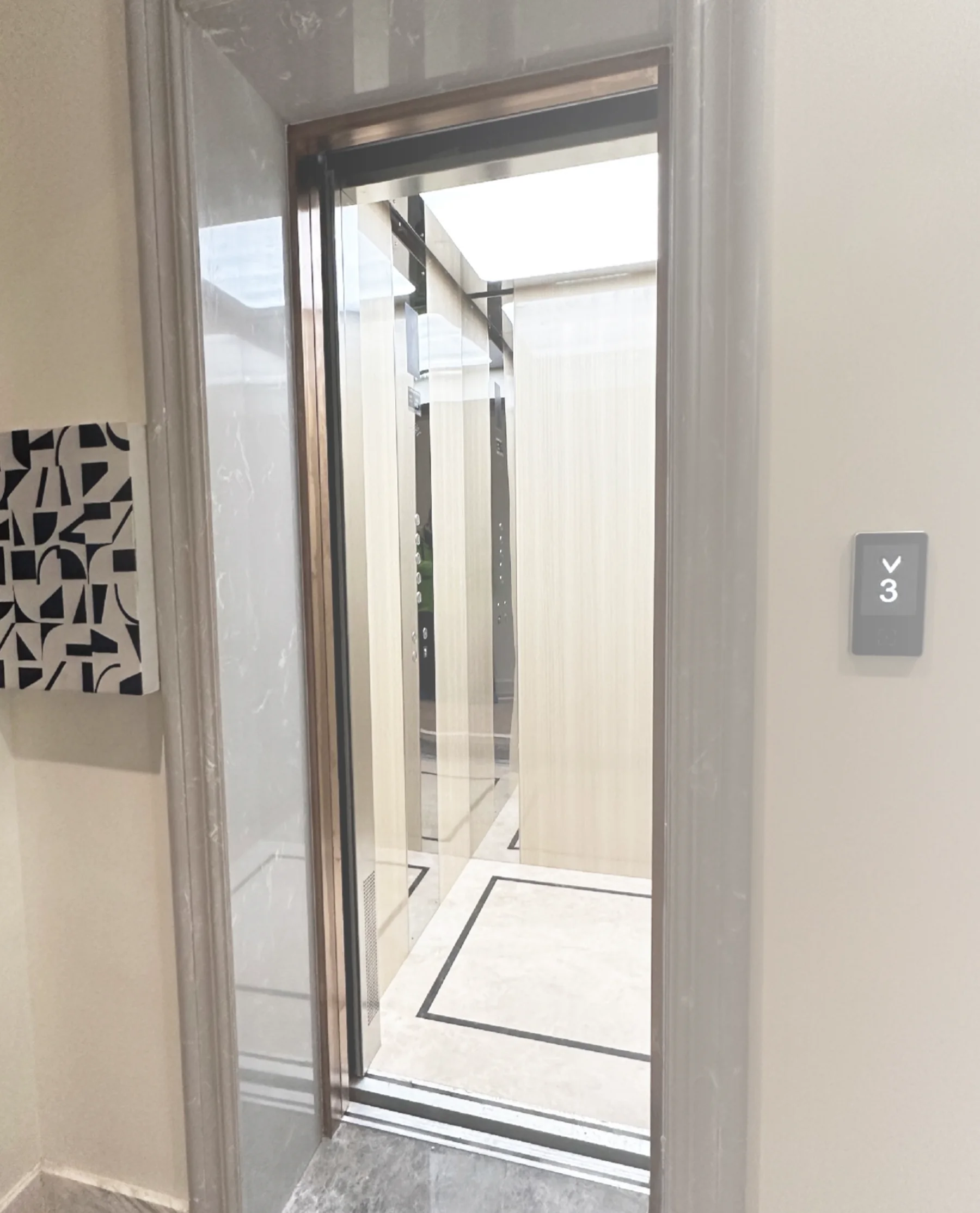
What battery driven means here
V300 is the SJEC V300 under the Tenkai badge. What is new is the drive: the battery system SJEC calls Cube sits on top of the existing traction machine rather than replacing it, so the mechanical specification is unchanged and the battery is an addition rather than a redesign.
The load-bearing word is only. The mains charges the battery; the battery drives the lift. A conventional lift is a motor the grid drives directly, and the grid absorbs every start. Here the grid never meets the motor. It meets a charger.
Almost everything else worth saying about this lift follows from that one change, so it is worth being precise about it before going further.
A lift is a strange electrical load
Two things make a lift awkward for a supply. The first is that it is spiky. A car starting draws far more than a car running, and a lift spends its working life starting — a few seconds of demand, a pause, a few seconds more. The supply has to be sized for the spike even though the average is small.
The second is that a lift generates. A loaded car going down and an empty car coming up are both being pulled by gravity, and for that part of the trip the motor is a generator. The electricity has to go somewhere.
Conventional drives send it to a brake resistor, which is a component whose entire purpose is to turn unwanted electricity into heat — a heater in a machine room, running so that the lift can stop properly. The V300's controller is an A3-size unit, 325 × 425 × 50 mm, and its specification lists no contactor, no cooling fan and no brake resistor.
Where the environmental case actually is
Four things, in descending order of how confident anyone should be about them.
No oil. Every model in the Tenkai range is traction driven. A hydraulic home lift holds a tank of oil that has to be changed and then disposed of, can weep past seals as they age, and shifts its speed and levelling as the oil warms through the day. Traction has none of that. The most environmentally useful thing about this lift is a consumable it does not have.
A smaller connection, not just a smaller bill. The machine is a permanent-magnet synchronous gearless unit of about 1.1 kW, and the lift runs on single-phase 220 V or on three phase. A house that does not have to be upgraded to three phase in order to have a lift is a house where the cabling, the switchgear and the works around that upgrade also never get built. The quietest environmental saving is usually the infrastructure nobody had to install.
Load moved rather than load added. Because the mains only charges, the timing of the draw comes apart from the timing of the trips. Charging overnight and running through the day is not a trick played on the meter; it is the default behaviour of the architecture.
Somewhere for a panel to put its output. The V300 is listed as solar-panel compatible, with panels supplied separately. Storage is the harder half of solar: a panel produces at midday, and a household mostly wants power in the evening. A lift that already keeps a charged battery is a load that can absorb generation when it happens rather than when it is wanted.
Why this matters on the Indonesian grid
The power cut is a design condition. Not an edge case to be handled by a rescue device that brings the car to the nearest floor and opens the doors, but an ordinary operating state the lift is expected to work through. The V300 is rated for about 250 floors of travel at full load unplugged. The number matters less than what it removes: for a household that installed a lift because somebody in it cannot manage stairs, a lift that stops during an outage is not an inconvenience. It is the temporary loss of the reason the lift was bought.
Connected load is bought, not assumed. An Indonesian household takes a connected load from PLN in fixed steps rather than an open supply, and a load that spikes is judged on its spike. Replacing a motor the grid starts with a charger the grid feeds changes the shape of what the house has to be rated for.
Off-peak is a grid question before it is a bill question. SJEC's own material presents the running-cost case as up to 40 per cent, on a time-of-use tariff, from charging off-peak and running on the battery at peak. Whether that holds for a particular house depends on the tariff that house is actually on, which is worth checking before it is counted on.
The infrastructure argument is the one that generalises. Whether shifting a load off the evening peak lowers emissions depends on what is generating at each hour, and that varies by grid and by season — it is not automatic, and it would be dishonest to claim it is. What moving load reliably does is lower the peak a network has to be built and maintained to meet. Multiplied across enough connections, demand that can be scheduled is capacity that never has to be poured, strung or shipped. A lift that can be told when to draw is a small instance of the thing an electrifying country needs a great deal of.
What it does not do
It does not make the lift carbon-free. The electricity still comes from wherever that grid's electricity comes from, and a battery moves consumption in time without reducing it.
It does not remove a disposal question, it relocates one. Hydraulic oil goes; a battery arrives, with a service life and an end-of-life of its own. That trade looks favourable over the life of an installation, but it is a trade and should be described as one.
It does not come with solar. The panels are supplied separately, and sizing an array is a separate exercise from specifying a lift.
And it does not reduce maintenance. A battery-driven lift has the same doors, ropes, guides and safety gear as any other, and they wear at the same rate.
The case for the V300 is not that it is a green product in the abstract. It is narrower and more defensible than that: it is a lift that asks less of a house's supply, and keeps working when that supply stops.
Worth establishing before specifying one
- The house's connected load, and what else starts on it
- Whether three phase exists, and whether it is worth having
- Which PLN tariff the household is on, and whether a time-of-use option applies
- Where the batteries sit, and what that space has to provide
- Whether solar is planned now, later or not at all
- Pit depth against the 300 mm minimum, and shaft width against 850–1,400 mm
Sources
Where this comes from
- SJEC V300 product documentation — Cube battery drive, controller specification and rated figures.
- Prawita Karya product range — V300 figures as published on this site.
- PLN tariff structure — Connected-load steps and time-of-use options referred to in general terms; no figures reproduced here.
FAQ
Common questions
Does the lift still work during a power cut?
Yes, and as normal service rather than as a rescue. The mains only ever charges the battery, so an outage removes the charger and not the drive. The V300 is rated for about 250 floors of travel at full load unplugged.
Does it need three-phase power?
No. The V300 runs on single-phase 220 V or on three phase. For a house without three phase, that removes a supply upgrade from the project.
Will it fit my house's existing connected load?
Usually the question is not the lift's rating but what else in the house starts at the same time, which is why it is answered from the actual supply rather than from a catalogue. Send us the connected load and our engineers will work it through.
Does the V300 recover the energy a descending car produces?
Its controller specification lists no brake resistor, which is the component a conventional drive uses to turn that energy into heat. Where the energy goes instead is a question for the manufacturer rather than something to infer from the absence of a part.
How long does the battery last, and what happens at the end of its life?
The battery is a serviceable component with a finite life, monitored by the battery management system the V300 carries as standard. Prawita Karya does not publish a replacement interval, because it depends on duty and on how the lift is used.
Can it run on solar?
It is listed as solar-panel compatible, with panels supplied separately. What an array needs to cover depends on the number of floors, the traffic and the tariff, so it is sized against a specific installation rather than against the model.
Is it actually cheaper to run than a conventional home lift?
SJEC's material presents up to 40 per cent, on a time-of-use tariff, from charging off-peak and running on the battery at peak. That figure assumes a tariff with a peak and an off-peak rate; on a flat tariff the saving is whatever the drive itself is more efficient by, which is a smaller and different claim.