Maintenance
Elevator Maintenance Checklist: What a Scheduled Visit Covers
A scheduled elevator maintenance visit covers four zones — machine room, car, shaft and pit, and emergency systems — working through roughly forty defined check points that cover the drive and brake, the governor and safety gear, door equipment, levelling, and emergency communication.
- Written by
- Calvin A. W
- Technical review
- Tommy C
- Published
- Updated
- Reading time
- 8 min
Why the checklist is fixed
Maintenance is not an inspection tour. It follows a defined sequence, because the failure modes that matter in vertical transport are progressive rather than sudden — a brake gap that has drifted, a rope losing diameter, a door shoe wearing thin. Each is invisible until measured, and each is entirely predictable if it is.
Working to a fixed list also makes the record comparable between visits. A brake gap measurement means little on its own; the same measurement across four visits shows a trend, and a trend is what tells you whether to adjust now or replace at the next service window.
The list below is the sequence Prawita Karya technicians work through, grouped by where in the installation each check happens.
Machine room
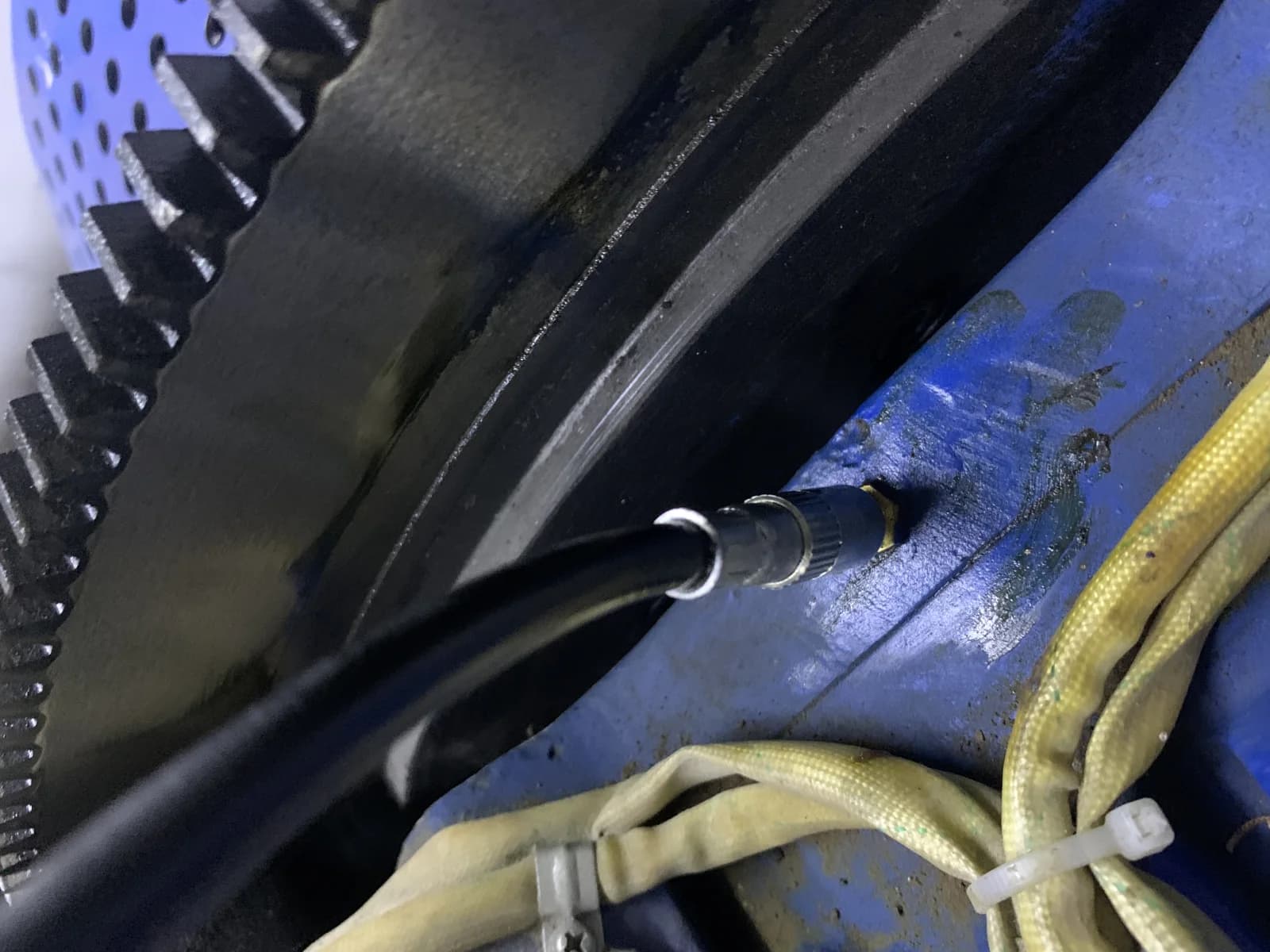
The machine room holds the drive, the brake and the governor — the components whose failure has the most direct safety consequence. Most of the measurement work happens here.
Machine room check points
- Grease the main sheave, deflector pulleys and encoder
- Clean and inspect the governor; adjust the governor pendulum
- Test the governor pendulum switch
- Clean the brake drum
- Measure the brake gap and the magnetic brake stroke
- Clean the control panel and inspect relay contact points
- Clean and check the rotary encoder
- Check RS supply voltage
- Clean and test the machine room interphone
Car
Door equipment works harder than anything else in an elevator, because the door operator cycles on every trip. Most call-outs originate here, which is why the car checks concentrate on doors, levelling and passenger-facing systems.
Car check points
- Car lighting and emergency lighting
- Car interphone and inspection box
- Manhole condition and fixings
- Car gate switch, door switch and door lock
- Door shoes and car door sill cleaning
- Door-to-jamb clearance on opening and closing
- Levelling accuracy verified at every floor
- Microscan door protection operation
- Vibration and ride quality check
Shaft and pit
The shaft and pit hold the safety chain — the devices that arrest the car if anything else fails. Because they only act in an emergency, verification is the only way to know they still work.
Shaft and pit check points
- Rail oil cups topped and guide shoes inspected
- Suspension rope diameter and tension measured
- Safety gear switch and safety wedge assembly
- Gripper clearance and alignment
- Buffer switch operation
- Pit stop switch and pit interphone
- Terminal limit switches: ULS/DLS, FLSD/FLSU, SDSU/SDSD
- Car counterweight and compensating pulleys
Emergency and fire systems
These are the checks that matter on the worst day. A fireman's switch that has never been tested is indistinguishable from one that works.
Emergency check points
- Fire switch operation
- Fireman's key and parking switch
- Emergency lighting duration
- Emergency communication answered end to end
- Manual evacuation equipment present and serviceable
What the record should show
A visit that produces only a tick sheet has wasted most of its value. Measured figures — brake gap, rope diameter, levelling deviation — are what let the next engineer see a trend rather than a snapshot.
Ask your provider for the measured values, not just confirmation that the visit happened. If they cannot produce them, the measurements probably were not taken.
Sources
Where this comes from
- Prawita Karya maintenance records — Check point sequence used on scheduled visits.
- SJEC equipment documentation — Manufacturer maintenance requirements for supplied equipment.
FAQ
Common questions
How long does a scheduled maintenance visit take?
It depends on the equipment, its duty and how many units are covered in one attendance. The checklist above is worked through in full on a routine visit; a first visit to unfamiliar equipment normally takes longer, because the baseline measurements have not been taken yet.
Does the lift need to be out of service during maintenance?
For parts of the visit, yes. Work in the shaft, pit and on the car requires the unit to be taken out of passenger service. In buildings with more than one lift the work is sequenced so an alternative stays available.
What should I receive after each visit?
A record of the check points completed and, more usefully, the measured values taken — brake gap, rope condition, levelling deviation. Those figures are what make the next visit meaningful.