Building Design
MRL vs Machine Room Elevator: Which Suits Your Building?
A machine-room-less (MRL) elevator places the drive inside the shaft, removing the need for a separate machine room above it. A traditional machine room elevator houses the drive in a dedicated room, which costs floor area but makes servicing easier and suits higher speeds and heavier loads.
- Written by
- Calvin A. W
- Technical review
- Tommy C
- Published
- Updated
- Reading time
- 7 min
What actually differs
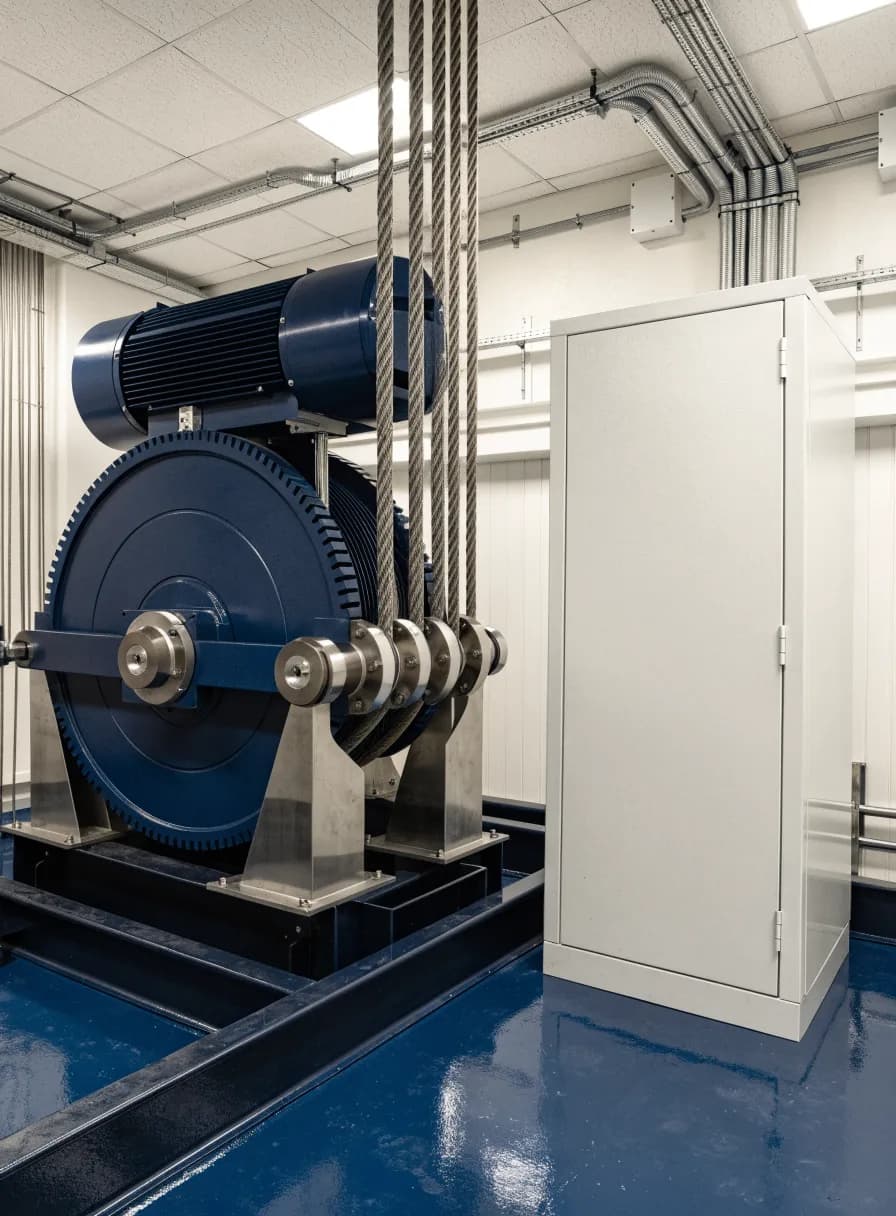
In a traditional installation the traction machine, controller and governor sit in a room above the shaft. In an MRL installation the machine is compact enough to mount within the shaft itself, usually at the top, with the controller in a cabinet at a landing.
Everything else follows from that. MRL removes the machine room and its headroom, which frees floor area and simplifies the roof — often decisive on a constrained site or where planning limits building height.
Where each one wins
MRL suits low- and mid-rise buildings where floor area is expensive and duty is moderate: apartments, offices, hotels and retail. It is now the default for most such buildings.
A machine room installation remains preferable where speed and load are high, or where serviceability matters more than the floor area. Working on a machine in a proper room is simply easier than working on one inside a shaft, which matters over a thirty-year service life.
Choosing between them
- Constrained site or height limit — MRL
- Low to mid-rise, moderate duty — MRL
- High speed or high-rise — machine room
- Heavy or cargo duty — machine room
- Serviceability prioritised over floor area — machine room
- No practical space above the shaft — MRL
The SJEC range in practice
Prawita Karya supplies both configurations. In the SJEC range, M300 is the machine-roomless model and S810 the mini machine-roomless variant for tighter shafts. C300 is the machine room model, with M670 as a mini machine room option where a full room is not available but shaft mounting is not preferred.
For higher duty, E550 covers middle-speed and E500 high-speed applications, while A100 handles cargo duty up to 5,000 kg and S100 provides a machine-roomless cargo option.
Decide it at design stage
This is a decision to take while drawings can still change. The shaft, pit, headroom and machine space follow from it, and all four are fixed in concrete early. Retrofitting from one configuration to the other is possible but rarely economic.
Sources
Where this comes from
- SJEC product range — Model designations from the SJEC elevator range supplied by Prawita Karya.
FAQ
Common questions
Is an MRL elevator less reliable than a machine room elevator?
No. The difference is where the machine sits, not how well it works. MRL equipment is mature and standard across most mid-rise buildings. The practical difference is serviceability: working in a machine room is easier than working within a shaft.
Does MRL save money overall?
It saves the floor area and construction of the machine room, which on a constrained site can be substantial. Whether that outweighs equipment cost depends on the building — it is a project calculation rather than a general rule.
Can an existing machine room elevator be converted to MRL?
Technically possible, rarely economic. The shaft, headroom and structural provisions were designed around the original configuration. Modernizing the existing installation usually delivers more for the same spend.