Home Lift
Can a Home Lift Be Installed in an Existing House?
Yes. If there is a vertical route that connects every floor for the shaft, a lift can go into a finished house, although like any renovation it involves some civil work.
- Written by
- Tony Topan Sukotjo
- Bachelor of Electrical Engineering; Ahli K3 Spesialis Bidang Elevator & Eskalator
- Published
- Updated
- Reading time
- 5 min
What decides it
The deciding question is whether a vertical route connects every floor. Like any home renovation, adding a lift to a finished house comes with some civil work, but that does not rule the lift out.
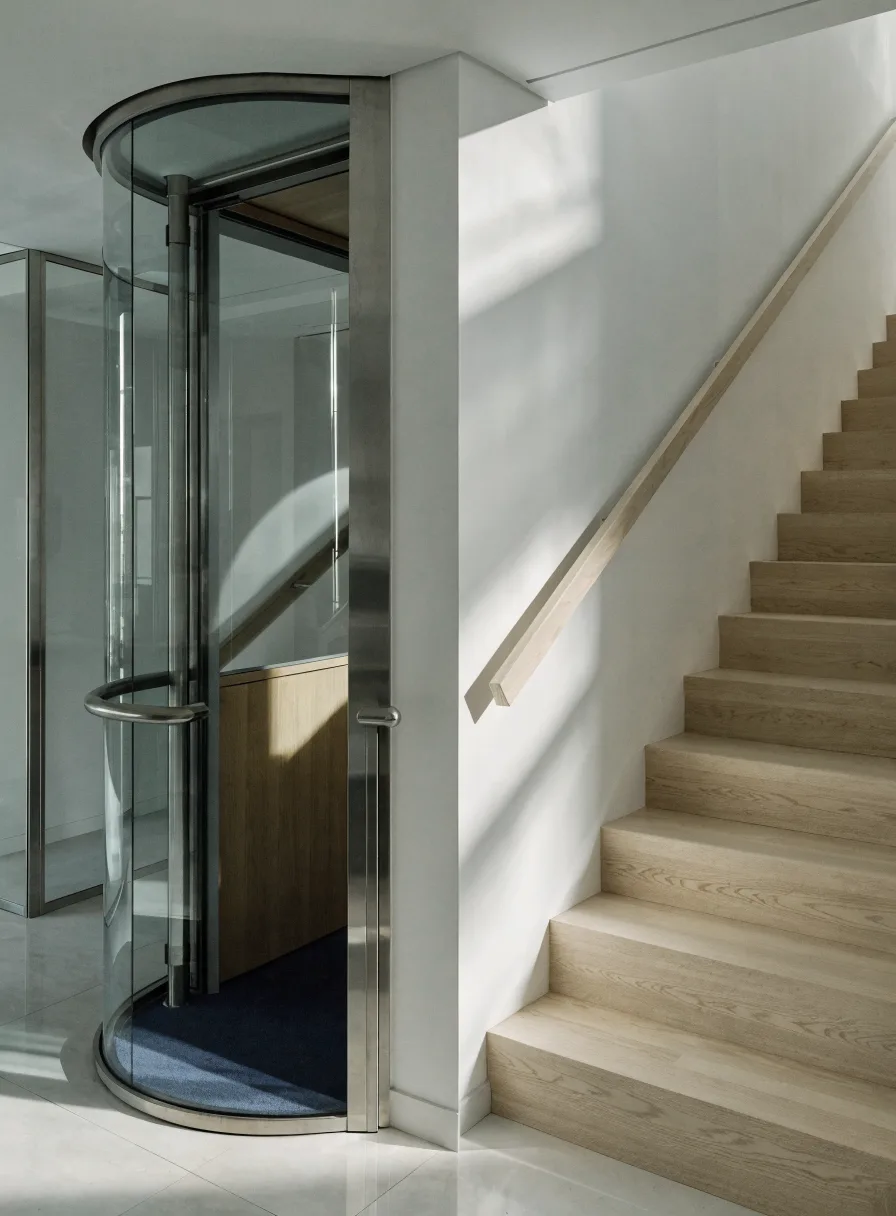
Spaces that already run up through the house are the natural place to start, because the floors there are already open or easy to open.
Places that can take a shaft
- An air-circulation void
- A stair void
- The outside of the house
What the survey checks
Prawita Karya surveys the house before recommending equipment, because these are site questions and not catalogue ones.
On a survey
- Where the shaft can run through every floor
- What the slab and foundations can carry
- How deep a pit the ground allows
- How much overhead there is above the top floor
- Where the door opens on each floor
- What supply the house has
Keeping the civil work small
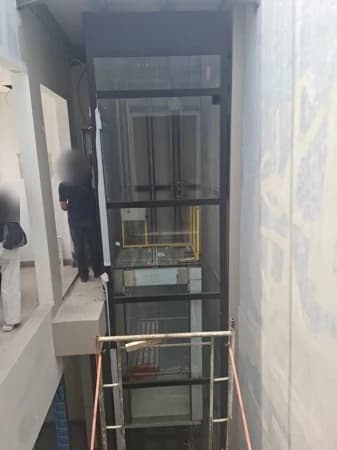
An aluminium or steel frame can replace a built shaft. It needs little more than clear space and an opening for the lift door at each floor. Tsuki has an integrated aluminium and glass shaft, and Kaze brings its own frame and installs without additional civil construction.
Home lifts also ask for little pit and overhead, which helps where site conditions are tight. A pit is sometimes not needed at all: Tsuki needs none, while Kaze, Mizu and V300 need 150 to 300 mm.
How the job runs
The order matters more than the speed: equipment is chosen after the survey, not before it, so nothing is ordered for a space that cannot take it.
From survey to handover
- Site survey and measurements
- Choosing the model and shaft type
- Civil preparation
- Installation
- Testing and commissioning
- First K3 inspection (riksa uji), included in Prawita Karya's scope
- Handover and maintenance
How long it takes
Allow about three and a half months from order to handover. On a project still under construction, shipping usually starts once the building has topped off or the house's roof has been cast.
Civil work is usually done by your contractor unless the contract says otherwise. If the lift is mounted on brackets supplied by Prawita Karya, no civil work is needed around the lift.
Typical timeline
- Production: around 2 months
- Delivery from port to door: around 2 weeks, depending on weather, port congestion and Indonesian customs
- Installation, testing and commissioning: less than 1 month, ready for handover
When the answer is no
It is rarely the size of the house. A lift becomes impractical when no continuous vertical route can be formed, when the structure cannot carry the load and cannot reasonably be strengthened, or when there is not enough overhead for any model. Where a standard shaft is impossible, Prawita Karya also supplies a shaftless home lift for two floors and a wheelchair platform lift for short rises.
Sources
Where this comes from
- Prawita Karya engineering — Installation practice and project examples.
- Prawita Karya home lift range — Tenkai model figures as published on this site.
FAQ
Common questions
Why use an aluminium or steel frame for the shaft?
It needs little civil work: prepare the empty space and the door areas. Sometimes no pit is needed, and if one is, it is shallow.
How long does it take to install a home lift?
About three and a half months from order to handover: around two months of production, around two weeks of delivery and less than a month on site.
Who does the civil work?
Usually your contractor, unless the contract says otherwise. If the lift is mounted on brackets supplied by Prawita Karya, no civil work is needed around the lift.
Can a lift be installed outside the house?
Yes. The outside of the house is one of the places a shaft can go, provided it can connect to every floor. The survey confirms what the structure and the site allow.
Can a lift go in the stair void?
Often, yes. A stair void already runs through every floor, which makes it one of the first places to look.
What if the pit cannot be dug?
Tsuki needs no pit at all, so it is the first model to consider. The survey will show whether another model can work with a shallow pit.