Home Lift
How Much Power Does a Home Lift Need?
A standard home lift needs a single-phase supply of about 3 kVA (220 V, 13 A). The battery-driven Tenkai V300 draws about 1.1 kVA (220 V, 5 A) to charge its battery, and Prawita Karya still specifies 3,000 W as a safety margin.
- Written by
- Tony Topan Sukotjo
- Bachelor of Electrical Engineering; Ahli K3 Spesialis Bidang Elevator & Eskalator
- Published
- Updated
- Reading time
- 5 min
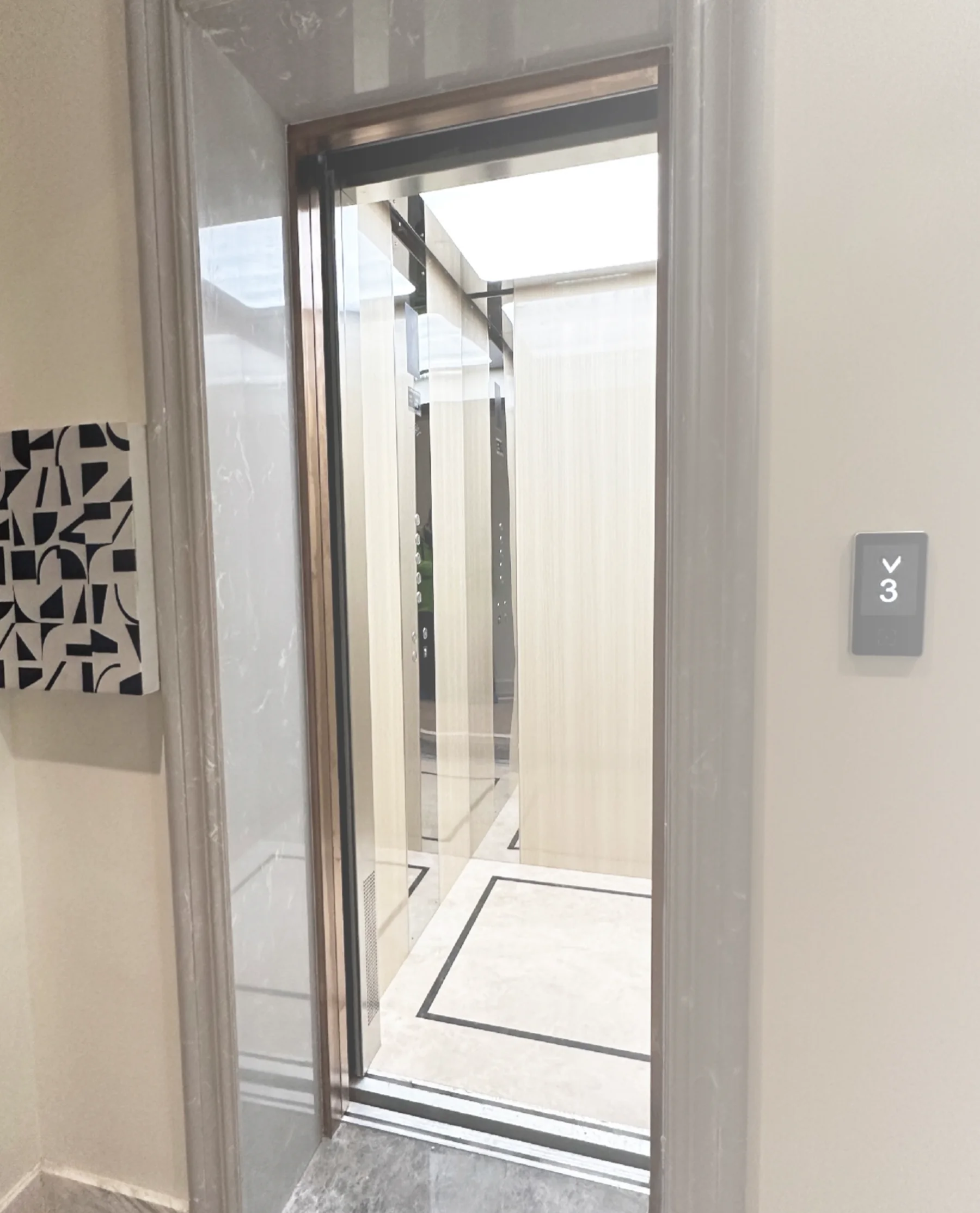
A single-phase house can still have a lift
A house on single-phase power does not need three phase to install a Tenkai home lift. Every model in the range is offered on a single-phase supply, so the question is usually how much power the house has spare, not which kind it has.
The figures come from simple arithmetic: volts multiplied by amps. At 220 V, 13 A is about 2,860 VA, which is why a standard model is quoted at about 3 kVA. At 5 A it is 1,100 VA, the V300's charging figure.
Supply at a glance
- Standard home lift: single phase, about 3 kVA (220 V, 13 A)
- Tenkai V300, actual charging draw: single phase, about 1.1 kVA (220 V, 5 A)
- Tenkai V300, supply Prawita Karya specifies: 3,000 W, as a safety margin
When you need to raise the PLN connection
A household buys its connected load from PLN in fixed steps, such as 2,200, 3,500, 4,400 or 5,500 VA, and the main breaker trips when the house draws more than that. So add the lift to everything else likely to run at the same moment: air conditioners, water heaters, the pump, the kitchen.
On those figures, a 3 kVA lift is more than a 2,200 VA connection can carry on its own, and would take most of a 3,500 VA one. Those houses should expect to discuss tambah daya. Larger connections depend on what else is running.
Send Prawita Karya your connected load and a list of the large appliances, and the engineers will work it through before you commit to anything.
Why a battery-driven lift changes the answer
A battery-driven lift always runs from its battery, and the mains only charges that battery. Other appliances in the house therefore do not disturb the lift, and unstable mains voltage does not directly affect its operation.
The real draw is about 1.1 kVA. Prawita Karya specifies 3,000 W anyway, because a supply that is only just large enough trips when something else in the house starts at the same moment. Treat 3,000 W as the figure to plan with.
When the mains goes off, the V300 keeps running until the battery reaches its minimum level. It is rated for about 250 floors of travel at full load unplugged.
Which should you choose?
If power cuts are common where you live, or your connection is already close to its limit, look at the V300 first. If the house has power to spare and you want more capacity or speed, a standard model such as Mizu may suit better, with up to 630 kg and 1.0 m/s.
Prawita Karya has installed Mizu and V300 home lifts in houses in Menteng, Kelapa Gading and Pantai Indah Kapuk, Jakarta.
Sources
Where this comes from
- SJEC V300 product documentation — Battery drive and supply requirements.
- Prawita Karya engineering — Supply figures, safety margin and project examples.
FAQ
Common questions
Does a home lift need three-phase power?
No. Both the standard models and the V300 can run on a single-phase 220 V supply.
Will I need to raise my PLN connection?
It depends on your connected load and what else runs at the same time. Houses on 2,200 VA or 3,500 VA should expect the conversation. Send us your connected load and we will work it through.
Why does the V300 specify 3,000 W if it only draws 1.1 kVA?
As a safety margin. The real charging draw is about 1.1 kVA, but a supply with nothing to spare trips when another appliance starts.
What happens if the battery runs low while the lift is moving?
The lift carries on at a lower speed.
What if the battery becomes too low for the lift to run?
The automatic rescue device (ARD) activates, and passengers can get out at the nearest floor.
Does an unstable supply affect the V300?
Not directly. The lift runs from its battery, so voltage rising and falling on the mains does not reach its operation.